Inspires Future Innovators at St. Joseph’s College
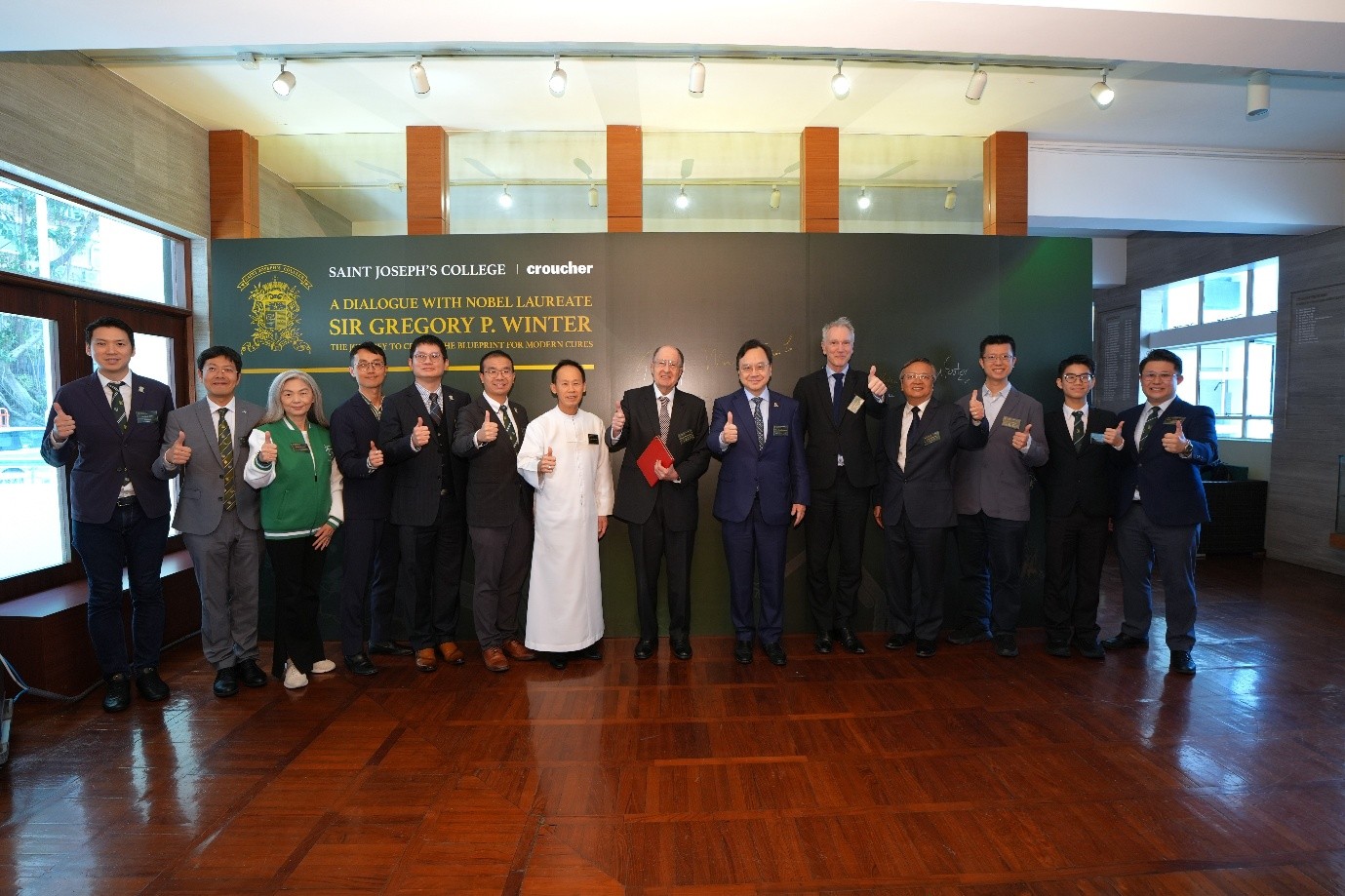
St. Joseph’s College, in proud partnership with The Croucher Foundation, successfully hosted an unprecedented educational event on 18th March, 2026: “A Dialogue with Nobel Laureate Sir Gregory P. Winter: The Journey to Create the Blueprint for Modern Cures.” Initiated by our distinguished alumnus Professor Dennis Lo, Vice-Chancellor of The Chinese University of Hong Kong, the forum welcomed more than 400 students and educators from local and international schools across Hong Kong for this unique opportunity to engage with one of the world’s foremost scientists.
This highly anticipated event provided a platform for attendees to explore Sir Gregory’s remarkable journey, from his childhood curiosity to the groundbreaking medical discoveries that earned him the Nobel Prize. The dialogue successfully fostered a passion for science, leaving a lasting impact on the academic community.
Having Sir Gregory, the Chairman of the Foundation, share his insights and inspiring childhood story at St. Joseph’s College perfectly encapsulated the Foundation’s commitment to facilitating the exchange of ideas between local and international scientists.
A Dynamic Exchange Between Scientific Leaders and Future Innovators
The event commenced with a warm welcome message by Principal T. M. Kwok of St. Joseph’s College, who applauded the school’s deep commitment to nurturing young scientific minds to become insightful thinkers through its STEAM education. Through events like this dialogue, the school also aims to provide students with opportunities to learn from the very best and foster intellectual exchanges that will shape the future of scientific research.
The event featured a captivating keynote lecture delivered by Sir Gregory, who shared profound insights into his revolutionary work in protein engineering, followed by an interactive Panel Discussion and Q&A session. Moderated by young alumnus Mr. Lee Hok Lam, who is currently a medical student at The University of Hong Kong, the panel also included Professor Dennis Lo alongside Sir Gregory. The discussion ranged from the inspiration behind their research and the perseverance it requires, to the ethics of commercialisation and the emerging role of AI in scientific exploration in the medical field. These distinguished scientists shared more than just intellectual insights. They consistently reminded the audience of the importance of integrity, compassion, joy, reading, and experimentation. The Q&A session also saw enthusiastic participation from students, who engaged directly with the esteemed speakers in a dynamic exchange of ideas.
The Spark of Innovation: Tracing Sir Gregory’s Path from Youthful Wonder to Medical Breakthroughs
Born in Leicester, UK, in 1951, and having spent part of his childhood in Ghana, Sir Gregory’s path to scientific eminence is a testament to the power of enduring curiosity. Learning from visiting physicists and marine biologists, and conducting experiments with his brother, all sparked a wonder about life that eventually drew him to science and experimentation. When he returned to the UK in his teens, he became enamored by Melvin Calvin’s Chemical Evolution, which shaped the trajectory of his research. He pursued his undergraduate studies at Trinity College, Cambridge, and later earned his PhD in 1977 from the prestigious MRC Laboratory of Molecular Biology (LMB). It was there that he mastered proteins and DNAs sequencing, what Sir Gregory described as ‘the tools and practices of the trades’.
Sir Gregory went on to revolutionise medicine during his tenure at the LMB. Recognising that the human immune system often rejected early mouse-derived antibodies, he pioneered techniques to ‘humanise’ them—genetically engineering the molecules to be accepted by the human body.
His most transformative breakthrough, however, was the development of “phage display”, a method utilising tiny viruses called bacteriophages to select useful antibodies that could potentially treat diseases. This pivotal discovery allowed scientists to rapidly develop powerful, fully human antibody drugs, leading to groundbreaking treatments for various diseases. In recognition of this pioneering work, Sir Gregory was co-awarded the 2018 Nobel Prize in Chemistry for “the phage display of peptides and antibodies.”
In addition to his Nobel Prize, Sir Gregory holds numerous esteemed titles, including Fellow of the Royal Society (FRS), Fellow of the Academy of Medical Sciences (FMedSci), and Commander of the British Empire (CBE). He is the Former Master of Trinity College, Cambridge, a Research Leader Emeritus at the MRC LMB, and currently serves as the Chairman of The Noel Croucher Foundation.
The Croucher Foundation: Empowering Hong Kong’s Scientific Community
The Croucher Foundation is an independent, private foundation established in 1979 by the late Noel Croucher (1891-1980). A legendary figure in Hong Kong, Mr. Croucher endowed the foundation with his entire fortune to give back to the community he called home for eight decades.
The Foundation’s primary mission is to promote the standard of natural sciences, technology, and medicine in Hong Kong. By providing scholarships and fellowships for promising young Hong Kong scientists, and by organising demonstration lectures for schools, the Foundation plays a vital role in fostering a wider understanding of science in the region.
Event Photos
https://drive.google.com/drive/folders/1t9HYjNDAW9FegY26JJxe3-i90jzl14bl?usp=sharing